
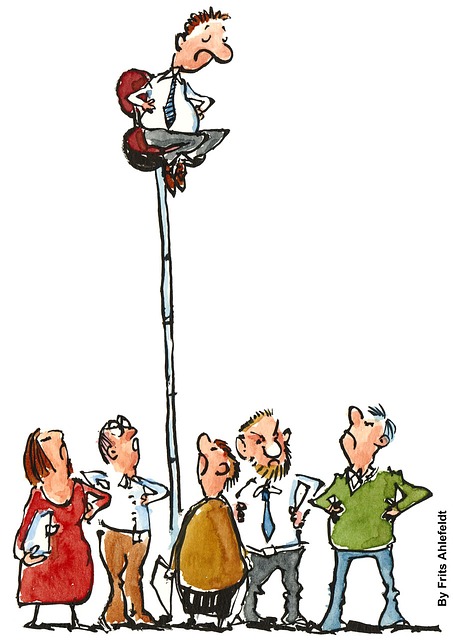
We live in a world run in a hierarchical format…it might make sense for evolutionary reasons, but it does not make sense for the human intellect. This hierarchical format puts limits on the abilities of the human brain. I remember how a colleague of mine with a research position higher than mine, i.e. “post-doc” while I am a doctoral student, told me “you can’t know everything” when I was informing him of a study I had read which had already researched the question he was asking. I told him, “I know I can’t know everything, but I can try”.
If you are capable, don’t let someone “higher up” tell you that you can’t
I believe in the value of learning the things that are both, directly and indirectly, related to my research. If I am studying the interaction between microplastics and marine food webs, then I better know whether there are computer models that depict the movement of microplastics through the water column. I should also know whether there are devices that are being developed to take seawater samples that can help with acquiring the data necessary for this type of model (this was actually what my colleague suggested was “out of my scope” of research). I need to know what is going on in terms of microplastic sampling techniques because the acquisition of data is completely relevant to the creation of a computer model. Why? Well, because when data is gathered from an in-situ experiment, there are a million variables that are out of our control. We cannot control the wind, current, sunshine, or temperature, but we can tell our computer these details which can ensure that the estimated result is as accurate as humanly possible. The details are important, but it’s hard to know which details are important if we do not have any knowledge about the indirect factors which influence our samples and the data which we acquire from them.
Is it wise?
The system needs to change because this post-doc assumes that his words are wise, where in reality his words could limit my intellectual development. If I believed in hierarchies I would have said, “You are right, I will focus only on the studies directly related to my research question.” And what is wrong with that? You might ask. Well, my research question is new, it has not been answered yet, much like all Ph.D. research questions. The point of research should be to gather information in which one can draw a conclusion/find a solution to an unsolved question. So anyway, if I focus my research energy only on the articles that directly focus on microplastic interaction with marine food-webs I’d have a total of 169 articles to read according to the Web of Knowledge search engine, as of today. That might seem like a lot, but realistically reading and analyzing 169 articles takes a handful of months and I have 3 years of a Ph.D.
So why does this post-doc suggest that telling me “You can’t know everything” is beneficial advice? I believe it is because he is not able or willing to do as much research as I am willing to do and so he says such a thing to protect his ego, to establish his status, to remind me that he is more experienced than I am, and to clarify that since he didn’t know what I knew, I obviously am learning something outside of the scope of the question. Given this example, I start to think that hierarchies are dangerous.
Hierarchies are dangerous…
especially in academia, because this structure allows, or rather ensures, that the ego takes precedent over the logos. The post-docs must know more than the doctoral students, the professors must know more than the post-docs and the doctoral students, etc. etc. That conclusion is not realistic, though. Age and experience seldom correlate with knowledge in my experience. Knowledge comes from research, from reading, from learning. These things take time, yes, but how many graduates do you know continue to read upwards of 50 scientific articles a day after receiving their diplomas? How many professors do you know who read and listen to learn rather than speak to teach?
Hierarchies inhibit the freedom to think
Yes, students should learn the information necessary to acquire a satisfactory knowledge of a topic, however, they should also have the freedom to think outside of the box. This freedom, though, means that professors and post-docs then have the responsibility to keep up with their students and that is a threat to their position as the teacher. I believe that professors should learn! Why are they devoting their life to academia if they do not intend on the continuation of their own intellectual development? To me, this makes no sense at all, but I still rarely come across a professor who is willing to continue her or his own studies. Why? I ask.
I think the answer is that the hierarchical structure of society gives people the impression that once you reach a certain point in your career, your role shifts from learning to instructing which is a cherished position to be in. As an instructor, you have the privilege of telling others what to do. With this power, many people develop an ego that convinces themselves that, “I am right”…and that it is funny to say things like, “do as I say, not as I do.” Well, I think this is a dangerous mentality. I think it is a shameful mentality.
Poorly managed hierarchies exist and are prevalent
I do not write this to generalize those “higher up on the food chain” in academia and in the professional world. I have met many people who are “higher up” than me and inspired me with their willingness to listen and learn, I aspire to be like these people. However, there is a pandemic in the academic world, and it is not COVID-19. There is a pandemic of lazy and power-hungry individuals who make their way to professorship only with the goal of achieving a status that affirms what they have always wanted to hear, “now you can tell all the other ones below you what to do, you did your time, now it is their turn to obey”. This pandemic forces students to color between the lines defined by their narrow-minded superiors. It takes “development” out of Research and Development. It hinders progress.
I would like to think that many people are aware of this superiority complex pandemic that we face in academia and the professional world, I hope people are not blinded to this. After realizing this situation, though, the hard part is thinking of a solution. Hierarchies work, sometimes, when people are decent. Not everyone is decent, though. So how should the system change? What could replace a hierarchical society?
 The Science of Working Together