
I am a fast learner, always have been, not because I am particularly quick to understand, but rather, because I am willing to fall and fail. I was lucky enough to be raised by a talented gymnast, she never made me believe that falling was a bad thing when I was learning to ride a bike or playing on the trampoline. Actually, on the trampoline, we would practice falling and getting back up with something called a “butt drop”, where you bounce from your feet to your butt and get yourself back to your feet. The fall, in that drill, is a success if you can carry the momentum in such a way that it returns you to your feet.
Flashback to Ski Instructing
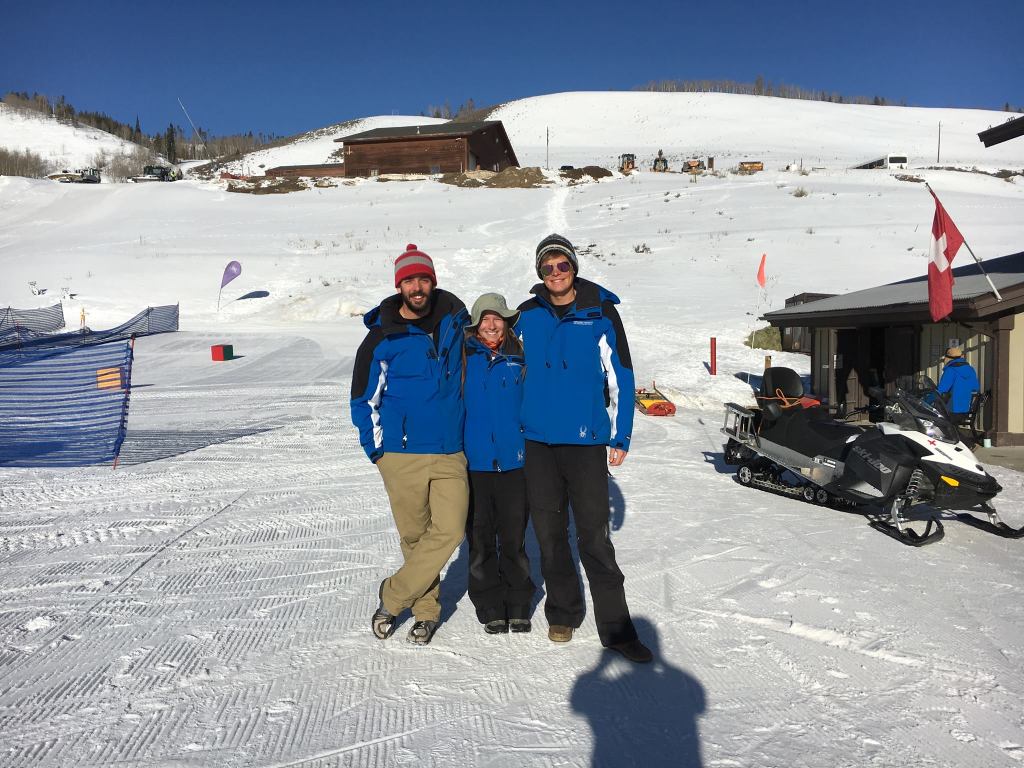
It wasn’t until I was teaching young children how to ski that I realized how important it is to be taught that it is ok to fall. My most successful students would usually fall more than the least successful students because they would push themselves past their limits so they could learn something new. If they made a mistake (often minor), they wouldn’t get mad at themselves because they knew they were just learning. I had a kiddo go from the bunny slope to moguls in two days and I don’t think it is a coincidence that he would laugh and pop right back up every time he fell on new and strange terrain. He was patient with himself and he really learned from each fall, asking, “why did I fall there? what did I feel?” Meanwhile, my least successful students would cry and throw a huge fit if they ever fell. Not only were they terrified of falling, but they were so incredibly hard on themselves if they did. I tried my best to cheer for them even louder when they fell compared to when they didn’t because I wanted to correct their skewed idea that falling means that they are not capable. I would often ignore the fall all together. For example, in situations where students were working on tighter turns and fell in the middle of a carve I would say something like, “WOW! Your knees were so much closer together on that turn! Could you feel how you let the mountain and gravity do its work?! That was amazing!” They would look at me so confused at first, feeling their hands on the snow then seeing me still standing, thinking (I imagine) “why am I being praised for wiping out?” However, their confusion would often shift to excitement and they would respond with, “Yeah, Miss Val! I was so much faster, too! That was awesome!”
Sports are an easy example to use when explaining the benefits of falling or failing on the road to improvement. Most athletes who have achieved a new technique in their career have experienced how a fall (or many falls) actually led to greater understanding of how to succeed. Athletes who push their limits accomplish their goals faster than those who were afraid to step out of their comfort zone. I would bet a hefty sum that the world’s most accomplished athletes believe that falling is a good thing. However, “falling” is not just important in sports. A willingness to “fall” in life has also helped me grow more quickly academically, professionally, and personally.
“Falling”, In Life
I am a bit of a no-filter person. I don’t think this is always a good thing, however, it has also allowed me to learn some important lessons very quickly. Why? Well, I’ve noticed that sometimes when I take risks, I can achieve a high reward. The feasibility of this is shown in the image below:

Where equal high and equal low mean that the risk and reward are proportional. Meanwhile negative indicates that there was a high risk and low reward and positive indicates a low risk and high reward. However, notice how equal low and negative have the same level of reward and more importantly, for the purposes of this discussion, how equal high and positive have the same level of reward. This is why it is not so easy to achieve a high reward without ever taking a risk because sometimes there exist situations where taking a high risk results in a high reward.
Now, I know some business analysts might look at this and say, “Well, no actually, the point of this schematic is to demonstrate that the the high reward can be achieved with a low risk approach and therefore it is important to determine the low risk approach that leads to the high reward.” Which is true, I agree. However, knowing which low risk approach to take in order to achieve a high reward does indeed take time, energy, and expertise. In life, we are not always so lucky to have this time, energy, and expertise available for each decision we make. Sometimes it can pay off to be more efficient rather than more calculated and sometimes the fast and risky approach leads to the same level of reward as the slow and calculated approach. Sometimes getting to the reward more quickly is the make or break of a successful outcome.
I prefer the fast and risky approach. I prefer to invite the possibility of “falling”. First, because it is more fun for me. Second, because I have seen how taking risks in my life has allowed me to succeed more quickly, even if I tripped along the way, because mistakes taught me what not to do, allowing me to continually improve. Key word is quickly. Life is short, I’ve known that since I was a child, and I don’t want to lose time by mapping out the most careful steps to take because in my experience, even negative outcomes have allowed me to learn. Learning gives me purpose, learning helps me grow, so I never feel that I’ve wasted time by making mistakes if those mistakes have allowed me to learn. In addition, “what not to do” is not always black and white. Some approaches that are wrong for one person are instead right for another (not talking about morals here, that is a different animal). For me, I learn best by taking chances because more extreme experiences (good AND bad) stay engraved in my memory, whereas mundane experiences are more easily tucked away into some dusty memory cabinet.
Why the No-Filter Approach Works for Me
My no-filter way of expressing myself is a reflection of my willingness to fall in sports and the skills I have built in doing so. When I would practice my “butt drops” on the trampoline, I learned that falling on my bottom can give me the momentum to move back up to my feet. In my pole vaulting, I learned that I had to run fast and jump confidently because I had crashed on the track when I tried running slowly and jumping cautiously. In my rock climbing I learned that I would tire more quickly and fall if I took too much time to choose the perfect hand or foot hold rather than trusting my own strength. On my skis, I learned how to lean forward especially on a steep slope because I had wiped out when I leaned back in fear.
These lessons are not just for athletes, I know because I am not just an athlete. In school, I learned that taking the risk of looking “dumb” by asking questions in front of the whole class helped me understand the content and sometimes also helped my peers improve their knowledge. Speaking my mind, even if not popular opinion, has helped me find the people in my life who truly understand me (or want to) and has identified those who do not. Making an absurd amount of grammatical errors while speaking Italian with Italians helped me learn a new language at a conversational level in a matter of months and has allowed me to start learning a new culture. Moving to a big city, taught me that I do not want to live in a big city ;). Offering my input as an “inexperienced and young” Ph.D. student to a group of seasoned experts in a scientific committee, has helped me gain confidence in my research and has lead to a collaboration with an institute that shares many of my own personal values.
Some Concluding Thoughts
These are my experiences and I recognize that not everyone is comfortable taking risks. I also recognize that I am still learning when to not take risks because my default is to do so. Furthermore, some people who do take the right risks end up with no reward. It is important to remember that no matter what approach you take, there is always the possibility that you might fall or you might fail because of factors that are out of your control. When a skier hits a chunk of ice on the slope, they will fall even if they had perfect technique and control. If an entrepreneur starts a business, it might fail if a pandemic hits, even if it offered a desired and meaningful service or product. I might damage personal and professional relationships by sharing my thoughts because of differing opinions and values (there is a fine line with this one). Life is naturally full of risk so it might be a good idea to use these risks to our advantage. Every outcome of our actions is an opportunity to learn and, from my perspective, it is never a mistake to learn. So, keep trying and keep falling! Falling is a good thing.
Much Love,
Val
 The Science of Working Together